
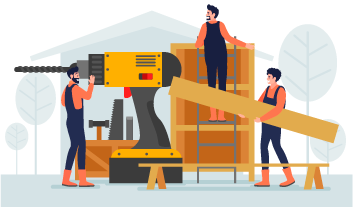
Carpentry requires a mix of technical knowledge, practical skills, and safety awareness.
 Measuring & Marking- Using a tape measure, ruler, and square accurately. Reading and marking dimensions precisely. Understanding fractions and unit conversions.
Cutting & Sawing - Using hand saws, operating power saws. Drilling & Fastening. Using a hand drill and power drill with appropriate drill bits for different materials.
Driving screws with a screwdriver or drill. Using nails, screws, bolts, and adhesives effectively.
Driving screws with a screwdriver or drill. Using nails, screws, bolts, and adhesives effectively.
Wood working Joints like Basic joints, Butt joint, lap joint, dado joint, and miter joint. Understanding how joints affect strength and durability. Using clamps to hold joints in place.
Sanding & Finishing like smoothing surfaces with sandpaper or power sanders, applying wood stains, paints, and protective finishes, sealing wood for durability.
Understanding Wood Types like Hardwoods and softwoods, choosing the right wood
for different projects, identifying wood grain and working with it.
Basic Framing & Assembly- Assembling wooden structures like frames, shelves, furniture; attaching hinges and brackets; reinforcing structures for stability.
Field trip to a working wood factory.
Measuring & Marking- Using a tape measure, ruler, and square accurately. Reading and marking dimensions precisely. Understanding fractions and unit conversions.
Cutting & Sawing - Using hand saws, operating power saws. Drilling & Fastening. Using a hand drill and power drill with appropriate drill bits for different materials.
Driving screws with a screwdriver or drill. Using nails, screws, bolts, and adhesives effectively.
Driving screws with a screwdriver or drill. Using nails, screws, bolts, and adhesives effectively.
Wood working Joints like Basic joints, Butt joint, lap joint, dado joint, and miter joint. Understanding how joints affect strength and durability. Using clamps to hold joints in place.
Sanding & Finishing like smoothing surfaces with sandpaper or power sanders, applying wood stains, paints, and protective finishes, sealing wood for durability.
Understanding Wood Types like Hardwoods and softwoods, choosing the right wood
for different projects, identifying wood grain and working with it.
Basic Framing & Assembly- Assembling wooden structures like frames, shelves, furniture; attaching hinges and brackets; reinforcing structures for stability.
Field trip to a working wood factory.